Fifth Heaven - God and All Angels
Overview
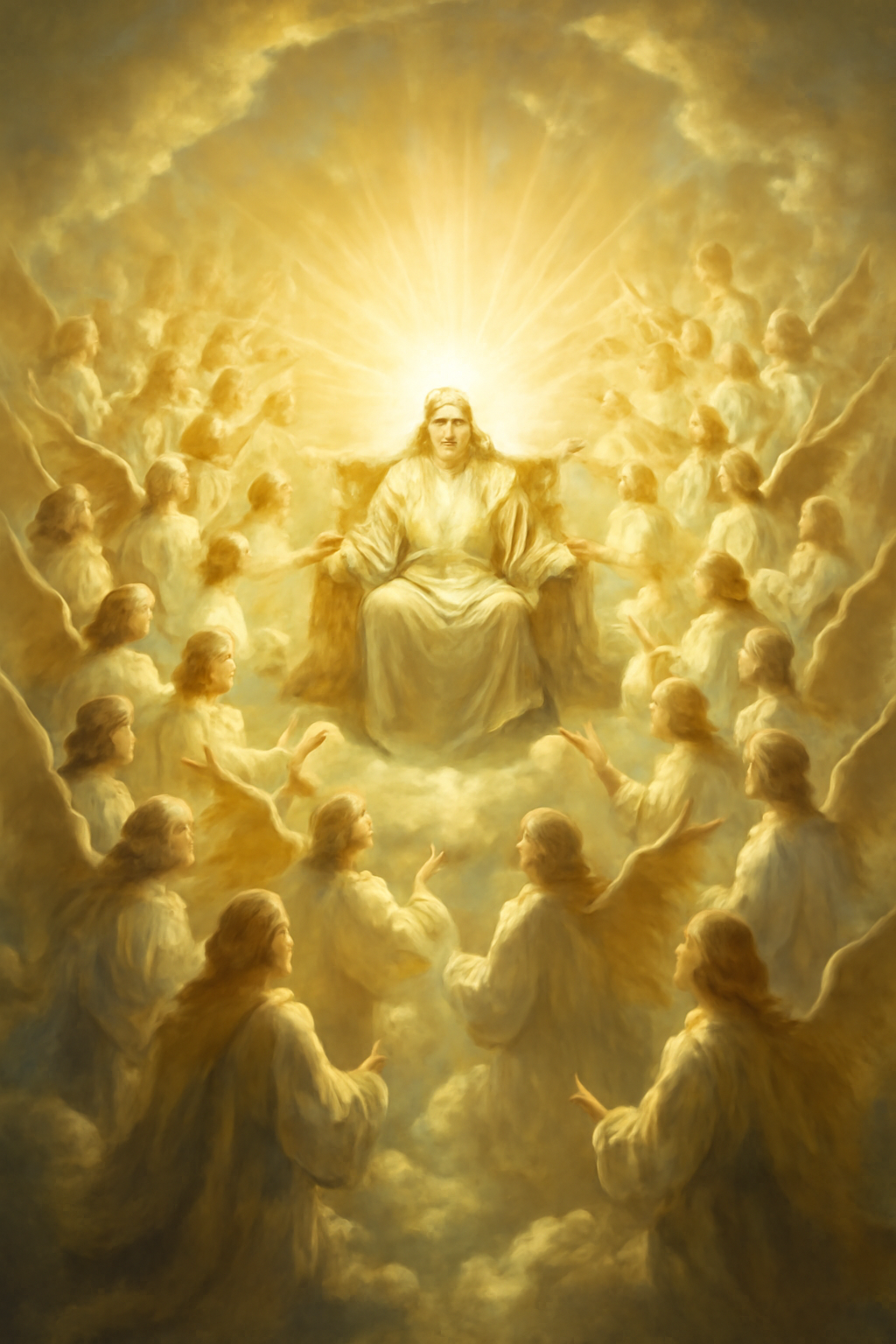
Majestic depiction of the Fifth Heaven where God reigns supreme, surrounded by countless angelic hosts in divine glory.
Biblical Commentary
Biblical Scripture does not present a single, standardized map of “five heavens,” yet later Jewish and Christian apocalyptic traditions often speak of multiple heavenly tiers to express the overwhelming transcendence and ordered majesty of the divine realm. Texts such as *2 Enoch* (Slavonic) and other Second Temple–era mystical materials (early forms of what later develops into *Hekhalot* / “Palaces” mysticism) describe several heavens populated by angelic liturgies and cosmic functions. When your scene depicts a “Fifth Heaven” in a pre-creation era, it is best read as a symbolic-theological tableau: before the visible world exists, God already reigns in uncreated glory, and heaven is portrayed as a temple-court where worship is perpetual and ordered. This emphasizes a key biblical conviction: creation is not the source of God’s kingship; rather, creation flows from the eternal sovereignty of the One enthroned. Theologically, the scene highlights two intertwined themes: divine transcendence and mediated praise. Biblical throne visions (notably Isaiah 6 and Revelation 4–5) portray God as incomparable—holy, enthroned, and surrounded by ministering beings whose ceaseless worship marks the boundary between Creator and creature. The “countless angelic hosts” underscore that even the highest spiritual powers are not rivals to God but attendants: angels serve, proclaim, and execute divine will. Spiritually, this setting invites contemplation of worship as the “first reality” of the cosmos: before human history, before earth, there is adoration and obedience. In biblical imagination, this also frames evil and suffering not as ultimate, but as later intrusions into a universe whose deepest structure is God’s holiness and reign. Historically, such imagery resonated profoundly in ancient Near Eastern and Second Temple Jewish contexts. Kings were imagined enthroned amid councils and courtiers; the Bible reconfigures that political-symbolic language to proclaim YHWH’s absolute kingship (e.g., “the LORD of hosts”). The “hosts” (Heb. *ṣĕbā’ôt*) evoke not only angelic armies but also the ordered heavenly realm—an assertion that every power is derivative and accountable. Read devotionally, the Fifth Heaven scene becomes a liturgical invitation: earthly worship participates in a larger heavenly reality, aligning human prayer with the angelic doxology and anchoring faith in the eternal rule of God that precedes and grounds creation itself.
Related Scripture
"“In the year that King Uzziah died I saw the Lord sitting upon a throne, high and lifted up; and the train of his robe filled the temple. Above him stood the seraphim. Each had six wings: with two he covered his face, and with two he covered his feet, and with two he flew. And one called to another and said: ‘Holy, holy, holy is the LORD of hosts; the whole earth is full of his glory!’”"
"“As I looked, thrones were placed, and the Ancient of Days took his seat; his clothing was white as snow, and the hair of his head like pure wool; his throne was fiery flames; its wheels were burning fire. A stream of fire issued and came out from before him; a thousand thousands served him, and ten thousand times ten thousand stood before him; the court sat in judgment, and the books were opened.”"
"“You are the LORD, you alone. You have made heaven, the heaven of heavens, with all their host, the earth and all that is on it, the seas and all that is in them; and you preserve all of them; and the host of heaven worships you.”"
"“At once I was in the Spirit, and behold, a throne stood in heaven, with one seated on the throne.” … “And the four living creatures, each of them with six wings, are full of eyes all around and within, and day and night they never cease to say, ‘Holy, holy, holy, is the Lord God Almighty, who was and is and is to come!’”"
"“The LORD has established his throne in the heavens, and his kingdom rules over all. Bless the LORD, O you his angels, you mighty ones who do his word, obeying the voice of his word! Bless the LORD, all his hosts, his ministers, who do his will!”"
Details
Share
Share this biblical scene with others